Healthcare Inspectorate Wales (HIW) uses intelligence to inform a risk based approach to regulating and inspecting healthcare in Wales.
Intelligence is information that helps us understand the quality and safety of healthcare services and identify where there may be risks or concerns. We bring together information from different sources to build a rounded picture, rather than relying on one piece of information.
This helps us target our work where it can have the greatest impact and respond to emerging risks across the healthcare system.
How we gather and use intelligence
Our work is informed by a wide range of intelligence, including:
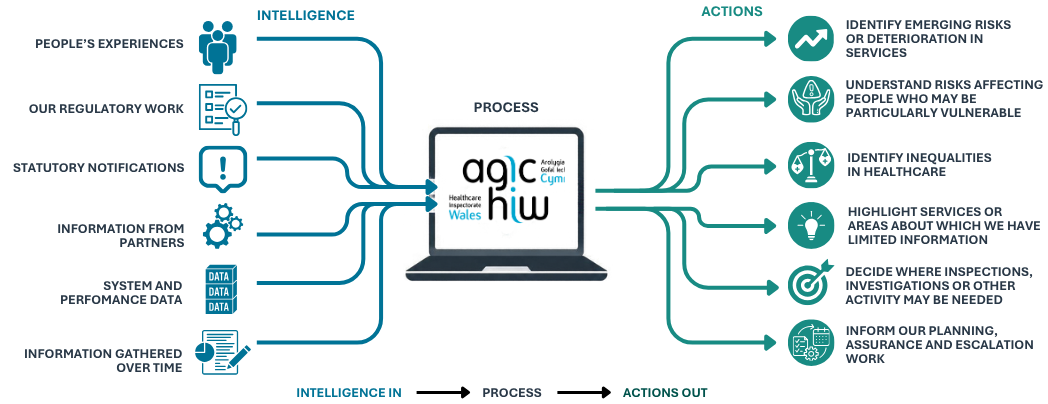
- people’s experiences: feedback and concerns shared by patients, families, carers and staff
- our regulatory work: evidence gathered through inspections, investigations, reviews and registration activity
- statutory notifications: information that healthcare providers are legally required to report to us, including Regulation 30/31 and IR(ME)R notifications
- information from partners: intelligence shared by organisations such as Audit Wales, Llais, the Public Services Ombudsman for Wales and Health Education and Improvement Wales
- system and performance data: Welsh Government data and other national information about healthcare services
- information gathered over time: patterns and themes identified across services, providers and different areas of Wales.
We bring these intelligence streams together to:
- identify emerging risks or deterioration in services
- understand risks affecting people who may be particularly vulnerable
- identify inequalities in healthcare
- highlight services or areas about which we have limited information
- decide where inspections, investigations or other activity may be needed
- inform our planning, assurance and escalation work.
Evidence from our inspections and investigations also becomes part of our intelligence. It may provide assurance about a service or indicate that follow-up work is needed.
We maintain an intelligence map to record the information available to us and how it is used. We review this regularly and update it when relevant new sources of information are identified.
How we identify and respond to risk
Our decisions about where to focus inspections and investigations are primarily risk-based and intelligence-led. Some activities are also carried out routinely to help us meet our statutory requirements.
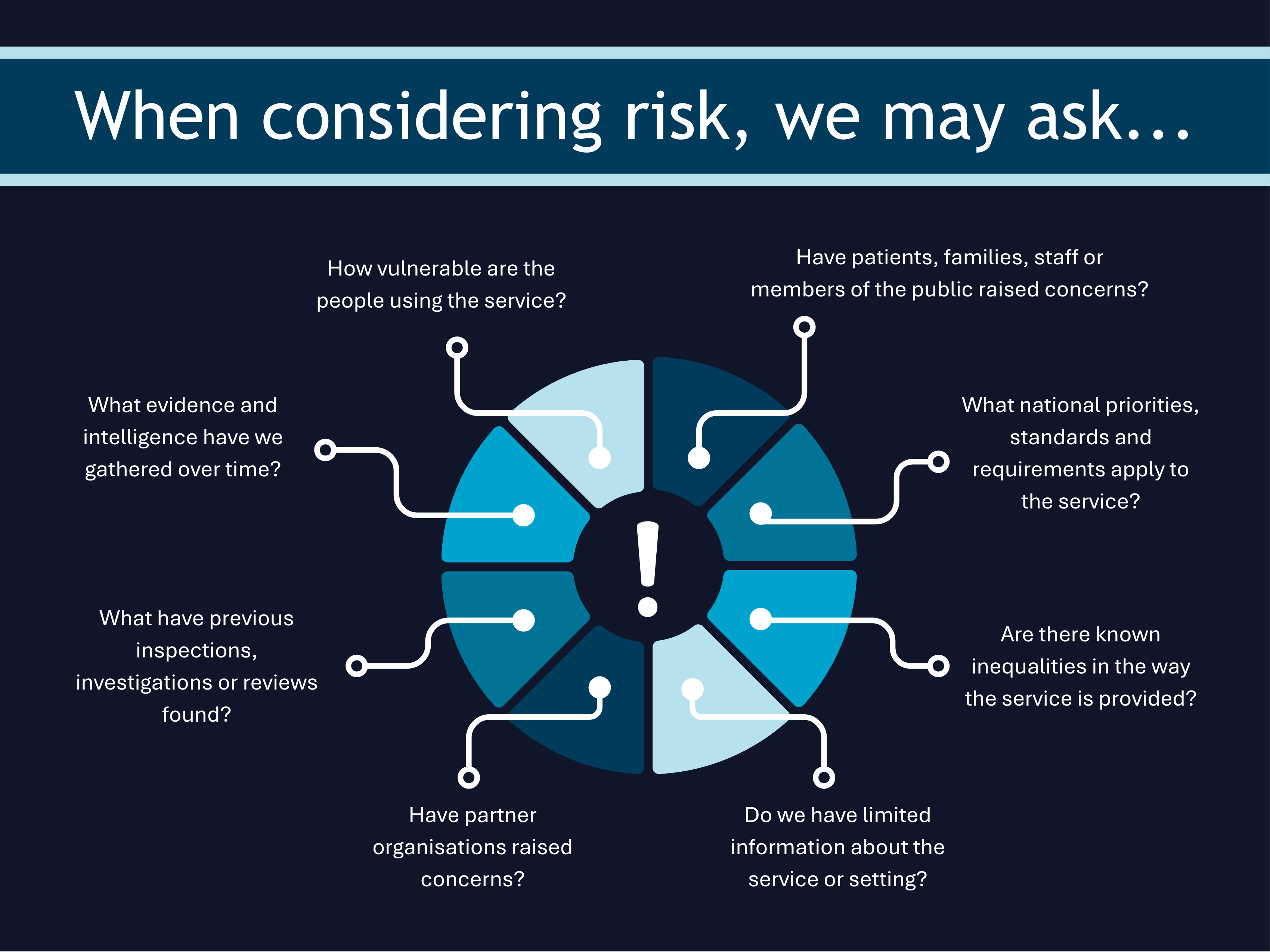
When considering risk, we may ask:
- How vulnerable are the people using the service?
- What evidence and intelligence have we gathered over time?
- What have previous inspections, investigations or reviews found?
- Have partner organisations raised concerns?
- Have patients, families, staff or members of the public raised concerns?
- What national priorities, standards and requirements apply to the service?
- Are there known inequalities in the way the service is provided?
- Do we have limited information about the service or setting?
Our decisions are based on the range of evidence available and are subject to scrutiny and challenge through HIW's internal governance arrangements.
When we receive information indicating an urgent risk to the quality or safety of healthcare, we have processes in place to respond quickly and take appropriate action.
Learning and working together
Our intelligence-led approach is underpinned by close working with organisations across the system.
We routinely share, receive and triangulate intelligence with partners to ensure that risks are understood collectively and responded to appropriately.
Twice a year, we host a Healthcare Summit that brings together review bodies and professional regulators, including Audit Wales, Llais, the Public Services Ombudsman for Wales and Health Education and Improvement Wales. The summit provides an opportunity to share and discuss intelligence about the quality and safety of NHS healthcare services in Wales. This helps inform our contribution to the Escalation and Intervention Arrangements for NHS Wales.
We engage with our Stakeholder Advisory Group and other representative bodies where appropriate to help us understand issues affecting patients, communities and healthcare services across Wales. We also have Memoranda of Understanding with partner organisations to support the appropriate sharing of intelligence.
Depending on the nature of the risk, our work with partners may result in:
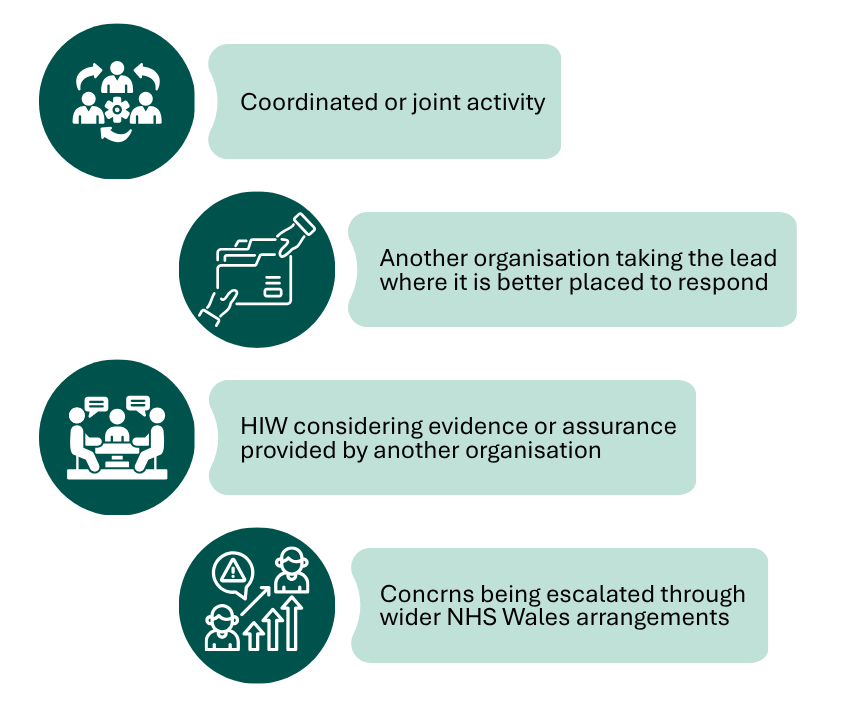
- coordinated or joint activity
- another organisation taking the lead where it is better placed to respond
- HIW considering evidence or assurance provided by another organisation
- concerns being escalated through wider NHS Wales arrangements.
Strengthening our approach
We are continuing to improve how intelligence is recorded, shared, assessed and used across HIW. Our ambition is to move towards a more structured, consistent and transparent intelligence model.
Within the health system in Wales, a significant amount of information is generated and shared between organisations. Our challenge is to identify which intelligence is most useful in helping us understand risk, target our activity and improve regulatory decision-making.
We use our intelligence map to identify and review the information available to us, ensuring that we focus on sources that provide meaningful insight into the quality and safety of healthcare services.
This includes:
- Developing a clearer and more consistent intelligence framework.
- Expanding and refining the range of intelligence sources we draw upon.
- Improving how intelligence is recorded, shared and challenged through our internal governance arrangements, including the Risk Assessment and Intelligence Group (RAIG) and Risk and Escalation Committee (REC).
- Enhancing our ability to identify themes and emerging issues across services and across Wales through analysis of intelligence and engagement with partners.
- Embedding a triangulated approach to intelligence within planning, escalation and assurance processes, including NHS planning arrangements.
By drawing on a broader range of information, we can better identify emerging risks, recognise patterns and trends, and target our inspection and investigation activity where it is likely to have the greatest impact.
Intelligence is strongest when information from different sources is brought together and tested through professional discussion. While data and intelligence play an important role in our decision-making, professional judgement, internal scrutiny and discussion with partner organisations remain essential. Testing and challenging our assessments helps ensure that our decisions are robust, proportionate and based on the best available evidence.
Influencing our outcomes
Through our work HIW seeks to influence four outcomes. This approach to risk based and intelligence led review activity supports these outcomes in a number of ways:
Outcomes | How does this strategy support these? |
| Provide independent assurance on the safety quality and availability of healthcare by effective regulation and reporting openly and clearly on inspections and investigations. | We will have a risk based and intelligence led program to ensure we focus our activity where it can have the greatest impact. The nature of this means we are likely to conduct work in areas where either the most vulnerable are affected or where we have concerns about the quality of a service or a visit hasn’t been conducted for a certain time period. Reports from these inspections will form part of our future intelligence. |
| Encourage and support improvements in care through reporting and sharing good practice and areas where actions is required. | Our investigations and inspections test organisations against published standards. Our transparent reporting can help them and others identify areas of improvement and also to share good practice. Intelligence shared with partner organisations assist us in ensuring the focus of our activity is appropriate and we have the greatest impact in improving the standard of care. |
| Place patient experience at the heart of our inspection and investigation processes. | Intelligence sourced from the public, patients, carers and staff are key components of how we determine our future activity. In addition, patient engagement and questionnaires are a key aspect of our inspection and investigation methodologies. |
| Use our experience of service delivery to influence policy, standards and practice. | Where we establish themes from our work programme we inform policy makers of our findings. We do this through letters direct to the Welsh Government and also openly through the publication of our suite of annual health board and thematic reports. |